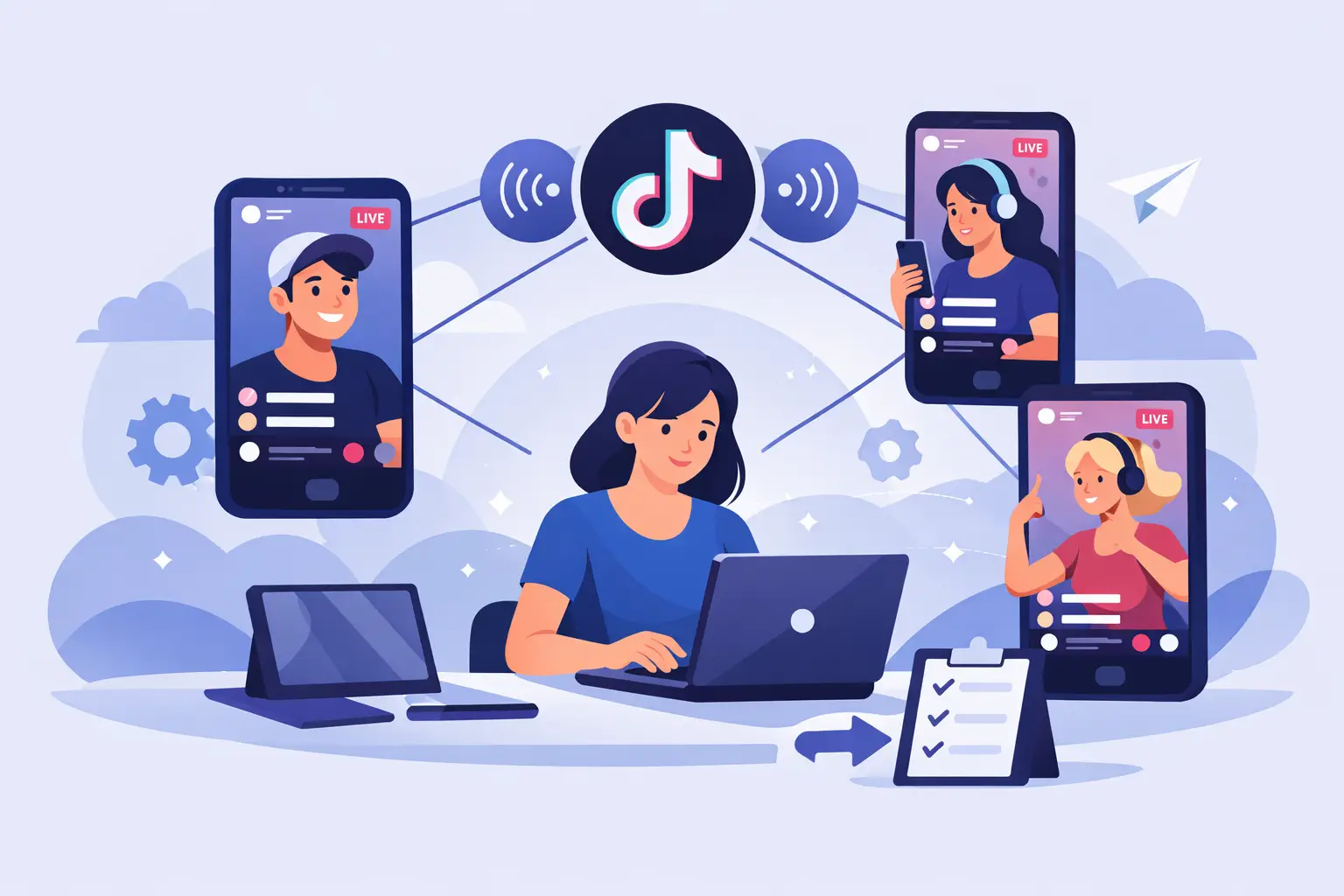
Running one TikTok LIVE account is already a lot. Running two, five, or twenty at once is where small mistakes turn into dead air, missed gifts, weak moderation, and a chat that loses interest fast. If you need to manage multiple TikTok LIVE accounts, you do not need more chaos. You need a system that keeps every stream active, every operator clear on their role, and every audience pulled into the action.
This is not just an admin problem. It is a revenue problem, a retention problem, and a momentum problem. When multiple accounts go live without a shared structure, the usual issues show up fast: the wrong tool gets activated, moderators respond too slowly, one creator gets all the attention, another stream feels flat, and gifting energy drops before it ever catches fire.
The fix is not piling on more people. The fix is better control.
Why managing multiple TikTok LIVE accounts gets messy fast
TikTok LIVE moves quickly. Viewer behavior changes by the minute, gifting spikes come out of nowhere, and stream energy can swing hard based on what happens on screen. That pace is exciting when you are focused on one account. Across several accounts, it becomes a coordination game.
The challenge is rarely just logging in and going live. The real pressure sits in the layers around the stream: who has access, who can activate features, who is watching performance, who handles support, and how each live session stays entertaining enough to hold viewers longer than the next stream in the feed.
Agencies feel this first. Creator teams feel it next. Then solo operators hit the wall as soon as they start scaling. What worked for one host with one format stops working when different creators need different setups, different schedules, and different engagement triggers.
That is why account management and audience participation have to work together. If your operations are clean but your lives are boring, scale does not help. If your content is exciting but your backend is sloppy, the cracks show up mid-stream.
How to manage multiple TikTok LIVE accounts without losing control
The smartest setup is centralized, role-based, and built for speed. You want one control layer for permissions, one rhythm for scheduling, and one clear process for activating the right live experience on the right account.
Start with access control. Not everyone should be able to do everything. Some people need account-level authority. Others only need to launch specific experiences, monitor performance, or support moderators. If too many people have full control, mistakes multiply. If too few people have access, streams stall while everyone waits for one operator.
Next comes planning. Every account should not run the exact same show unless that is the strategy. Different creators attract different crowds. One audience may respond best to head-to-head team competition. Another might go crazy for a reactive mini-game tied directly to gifting. Another may need a lighter format that fills dead moments without overpowering the creator. Good management means matching the stream mechanic to the account, not forcing every host into the same mold.
Then there is timing. If several accounts are live at once, you need to decide where the biggest engagement pushes happen. Not every stream needs the same intensity at the same moment. Some sessions should be built for volume, others for testing, and others for steady community retention. The more accounts you manage, the more important this becomes.
Build a real operating system, not a patchwork workflow
A lot of teams try to scale with chat apps, shared passwords, random notes, and last-minute decisions. That works right up until it does not. Once live pressure hits, patchwork systems create lag, confusion, and overlap.
A real operating system for multiple TikTok LIVE accounts needs four things: clear ownership, fast activation, visible status, and repeatable workflows. Clear ownership means every account has a responsible operator or manager. Fast activation means the right interactive tools can be turned on without digging through messages or waiting for approvals. Visible status means your team knows what is live, what is assigned, and what is running. Repeatable workflows mean your best-performing sessions can be repeated without rebuilding the process from scratch every time.
This is where a centralized admin panel changes the game. Instead of treating each account like a separate island, you manage users, durations, and project availability from one place. That keeps scale from turning into a mess.
For teams using gift-driven experiences, central control matters even more. Interactive formats only work when they are activated properly and matched to the creator's style. A control center lets you move faster without getting sloppy.
Manage multiple TikTok LIVE accounts with audience energy in mind
This is the part operators often miss. Managing accounts is not only about permissions and schedules. It is also about designing live moments that keep viewers participating.
TikTok LIVE rewards movement. A static stream with passive watching can survive for a while, but it struggles to build gifting momentum. Across multiple accounts, that problem gets bigger because stale formats become obvious. Audiences notice repetition. They feel low stakes. They leave.
The better move is to create live structures that give viewers something to do. That can mean competition, reactive mini-games, team-based outcomes, or any format where gifts and tokens trigger visible on-screen results. The point is simple: when audience actions produce instant chaos, rivalry, or progress, people stay longer and push harder.
That does not mean every account should run maximum intensity all the time. There is a trade-off. Too much noise can overpower a creator who wins through conversation or personality. Too little interactivity can flatten a stream that depends on hype. It depends on the host, the niche, and the crowd. Smart operators test formats account by account, then standardize what performs.
The best teams separate control from performance
One reason multi-account operations break down is that everyone ends up doing everything. The creator is hosting, the moderator is troubleshooting, the manager is chasing access issues, and nobody is fully focused on performance.
Separate the layers. Let creators create. Let moderators manage audience flow and keep chat clean. Let operators handle tools, availability, and session setup. Let managers watch the bigger picture across all live accounts.
When these roles are clear, streams feel tighter. Problems get solved faster. More important, performance data becomes easier to read. If one account underperforms, you can actually tell whether the issue was timing, creator energy, audience fit, or feature setup. Without role clarity, every bad stream just looks like random bad luck.
For agencies and creator groups, this is a huge edge. Instead of reacting after a weak session, you can build a system that prevents weak sessions from stacking up.
What a scalable setup looks like in practice
A scalable setup is boring in the backend and wild on the screen. That is the sweet spot.
In practice, that means creators do not waste time asking which tool is active. Managers do not have to chase who has access. Support teams do not scramble to figure out which account is tied to which campaign. Everything operational is organized before the stream starts.
Then the stream itself can do what it is supposed to do: create pressure, spark competition, and turn passive viewers into active players.
This is exactly why platforms built around centralized user management and TikTok LIVE interaction work better than generic workflows. If your team is handling account access while also trying to launch interactive experiences across multiple creators, one dashboard beats ten disconnected processes every time. StreamLive is built around that reality, giving operators one place to control access and run audience-driven live experiences without dragging creators into admin work.
Common mistakes when you manage multiple TikTok LIVE accounts
The biggest mistake is thinking scale is only a staffing issue. More people can help, but more people without structure just creates louder confusion.
The second mistake is copying the same engagement format across every creator. Standardization is useful, but clone-mode streaming gets stale. Audiences want tension, surprise, and moments that fit the host.
The third mistake is treating interactivity like an extra. On TikTok LIVE, audience participation is often the engine, not the decoration. If viewers can influence what happens, they have a reason to stay. If they can compete, gift, and trigger reactions, they have a reason to come back.
The last mistake is waiting too long to centralize operations. Most teams only fix their system after something breaks. By then, you have already lost sessions, momentum, and probably money.
What to focus on next
If you are trying to grow beyond one host or one live room, stop thinking in terms of separate accounts and start thinking like an operator. The goal is not just to keep streams running. The goal is to make every account easier to control and harder to ignore.
That means tighter access, clearer roles, smarter scheduling, and live formats that turn viewers into participants instead of spectators. Get those pieces right, and managing multiple accounts stops feeling like damage control. It starts feeling like leverage.
The best multi-account setups do not look calm because nothing is happening. They look calm because the chaos is happening where it should - on screen, in the competition, and in the chat.